
 You may not stop to think about your trash after it makes its way to the trash can, but what exactly happens next?
The District of Washington reported that in 2018 the Department of Public Works (DPW) collected 1,139,846 tons of waste and recyclables – including tires, hazardous waste, yard trimmings, biofuel, and waste-to-energy.
Waste Management in the District
The DPW is responsible for collecting residential waste and recycling for 105,000 single-family homes and buildings housing less than 3 housing units; multi-family and commercial buildings receive waste management services from private waste and recycling companies.
Waste reduction programs like the Department of Parks and Recreation and the Department of Energy and Environment employ collection teams for public spaces in the hopes of developing a zero-waste plan that attends to divert 80% of the district’s solid waste to reuse, recycle, compost, or anaerobically digest.
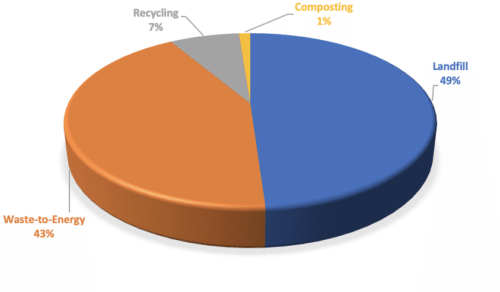
How does the city plan to achieve this goal? By educating its residents! Let’s take a look at Washington D.C.’s waste measurements to understand what your trash looks like and where it is likely headed. The pie chart breaks apart the types of waste into four categories: Landfill, Waste-to-Energy, Recycling, and Composting.
City-Wide Waste Estimates
According to the 2018 Solid Waste Diversion Progress Report, residential waste diversion surpassed 25%, with citywide diversion at 16% – well on its way to 80% within the coming decade.
Generally, once the DPW or private collections takes your trash, it is transferred to Covanta Fairfax Waste-to-Energy, a disposal site outside of the city in Fairfax, VA. Covanta is considered one of the largest waste facilities in the country and processes more than 3,000 tons of municipal solid waste per day for Washington, D.C. suburbs.
Of the 1.5 million tons of waste generated in 2018 – refuse, mixed recyclables, paper, and bulk items made up the top categories for disposal.
Where Does the Trash Go in Washington, D.C.?
If you are wondering where your trash goes in Washington, D.C., it’s likely turned into energy or taken to a landfill. The breakdown looks like this:
- 7% Recycled
- 43% Converted into energy
- 49% Landfilled
- 1% Composted
While waste and recycling are taken to multiple locations and transfer stations throughout D.C., Virginia, Maryland, and Pennsylvania – here are the top facilities for each according to the 2018 Solid Waste Diversion Progress Report:
Landfill
- King & Queen LF BFI in Little Plymouth, VA – 71,958 tons of annual waste.
- Middle Peninsula Landfill in Glenns, VA – 57,749 tons of annual waste.
- W Street Transfer Station in Washington, D.C. – 56, 984 tons of annual waste.
Recycling
- WM Recycle America in Elkridge, MD – processes 60,329 tons of recyclables annually.
- Republic Northern Virginia Recycling Facility in Manassas, VA – processes 29,219 tons of recyclables annually.
- World Recycling Company in Cheverly, MD – processes 24,442 tons of recyclables annually.
The Future of Waste in Washington, D.C.
The city continues to try to decrease the amount of landfill and disposal facilities waste with its 80% zero waste initiative; however, the program still has a long way to go. Learn more about the district’s sustainability plans.
You may also be interested to check out our other post, about what happens to garbage in the Philadelphia region.