
When you toss something in the garbage, you may never stop to wonder where it goes next. Or maybe, you join your kids’ excitement when the garbage truck comes – but never question where it goes after your neighborhood.
Atlanta produces 17.4 million tons of trash every year! That’s nearly the total weight of an estimated 5,700 fully loaded Boeing 747-8 airplanes or 57,000 Blue Whales. That is a lot of trash. In Atlanta, all of this garbage is transferred to a Waste Management transfer station.
Atlanta Waste Management
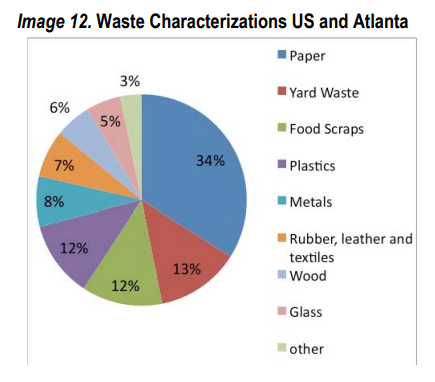
The Atlanta Office of Solid Waste is responsible for collecting trash within the city – serving nearly 100,000 residential households. As one of the largest cities in the United States, it takes a lot of support and money to manage Atlanta’s waste. The graph shows the percentage of what type of trash Atlanta produces. After this trash gets picked up in your neighborhood, it is taken to one of these transfer stations, all of which are in the immediate Atlanta area:
- Waste Management Atlanta Transfer Station
- Welcome All Transfer Station
- Doraville Transfer Station
- Bankhead C&D Transfer Station
- Merk Miles Transfer Station & Recycling Center
- Lee Industrial Transfer Station
After your trash arrives at a transfer station, it is sorted and sent to one of these area landfills:
- Safeguard Landfill – Fairburn, GA
- Eagle Point Landfill – Ball Ground, GA
- Dekalb County Landfill – Ellenwood, GA
- Wolf Creek Landfill – Dry Branch, GA
- Chadwick Road Landfill – Roswell, GA
- Southern States Landfill – East Point, GA
Recycling in Atlanta
Recycling materials must go through a transfer station as well, but typically recyclables end up at Fulton Industrial Boulevard. Once there, the materials are taken and processed at a state-of-the-art center – the Pratt Recycling Material Recovery Facility in Conyers. Just a decade ago, Atlanta struggled with improving opportunities to recycle. A new $4 million project, the Recycling Partnership, has changed that. Since 2017, the project has worked hard to increase access to recycling by:
- Bolstering single-family curbside participation and reducing contamination,
- Expanding multifamily recycling opportunities,
- Improving university recycling education and infrastructure.
Funded by Coca-Cola, in just the last 7 years, the recycling contamination rate dropped from 41% down to 31%, and the total weight of recyclables increased from under 10 tons annually before 2010 to over 14 tons. The City of Atlanta offers a recycling program that allows for curbside recycling but also offers resources for bulky items and hazardous waste through a partnership with Live Thrive.
Understanding Trash and Recycling in Atlanta
The city of Atlanta is currently pursuing several waste management initiatives. These include the aforementioned partnership with Live Thrive, as well as the Recycling Partnership funded by Coca-Cola. In addition, the city is attempting to restructure trash services and fees with the SMART plan. Originally drafted in 2012, this plan evaluates trash and recycling needs on an annual basis and takes into consideration poverty levels and access to recycling within the city.
A lot has been done in the last decade when it comes to Atlanta’s trash, but there is still room for improvement. Next time you throw out a banana peel or a piece of garbage, you won’t have to ask, “Where Does the Trash Go in Atlanta?” At least for now, you know. Need a dumpster in Atlanta? We have you covered!